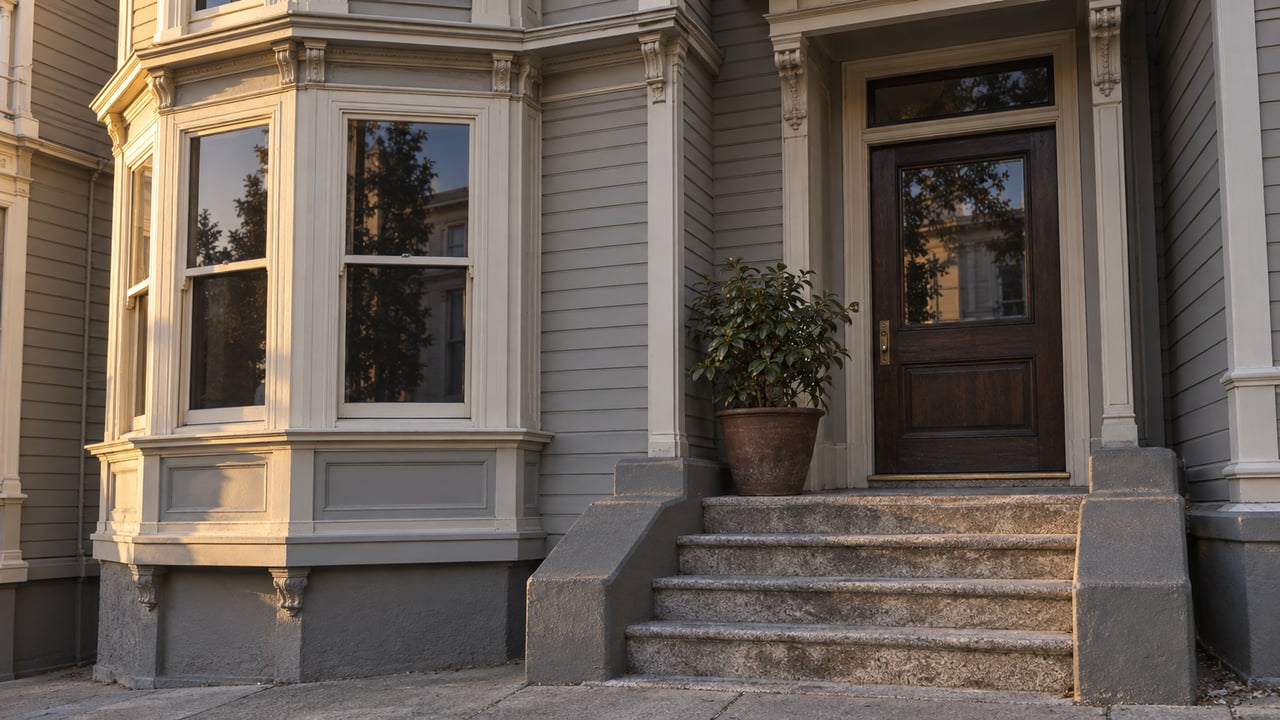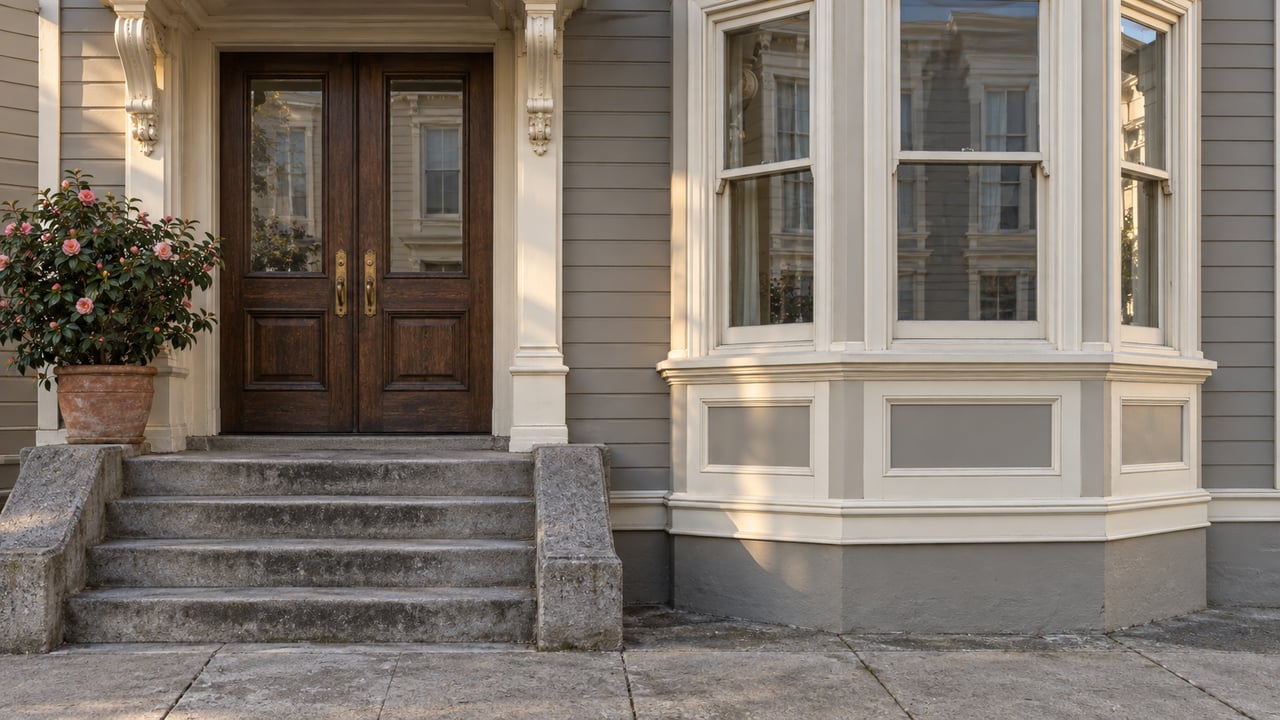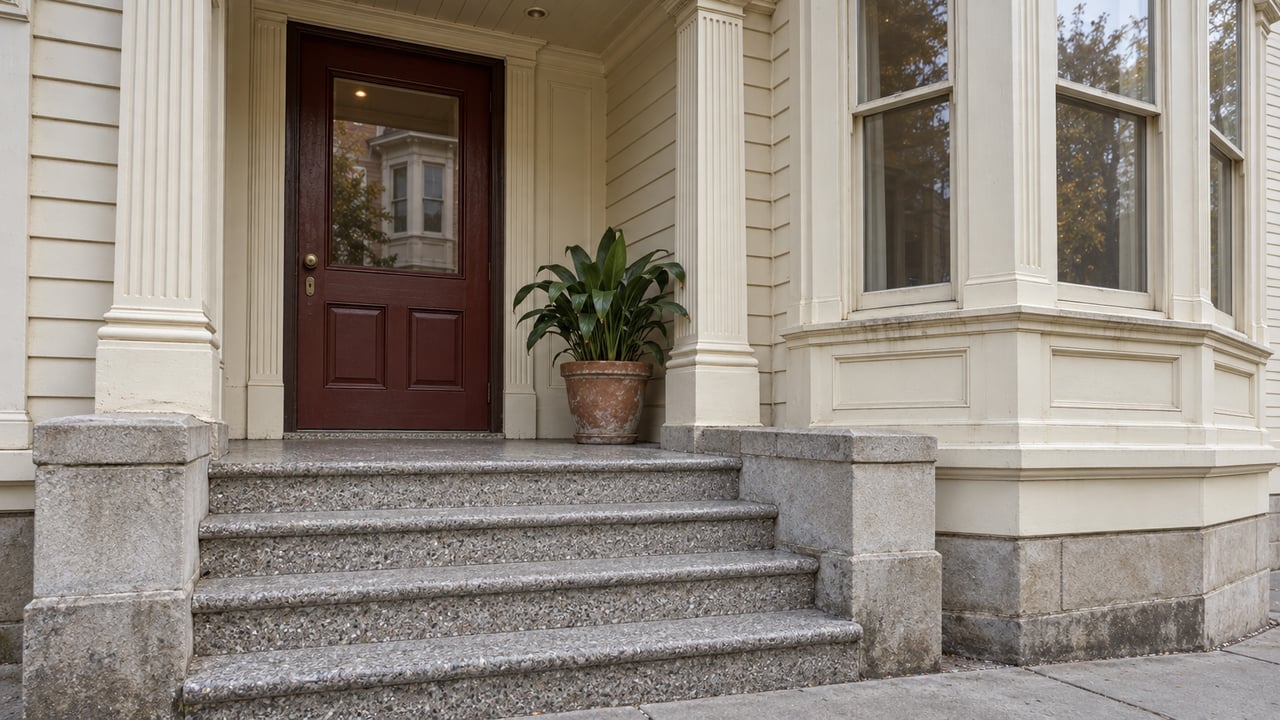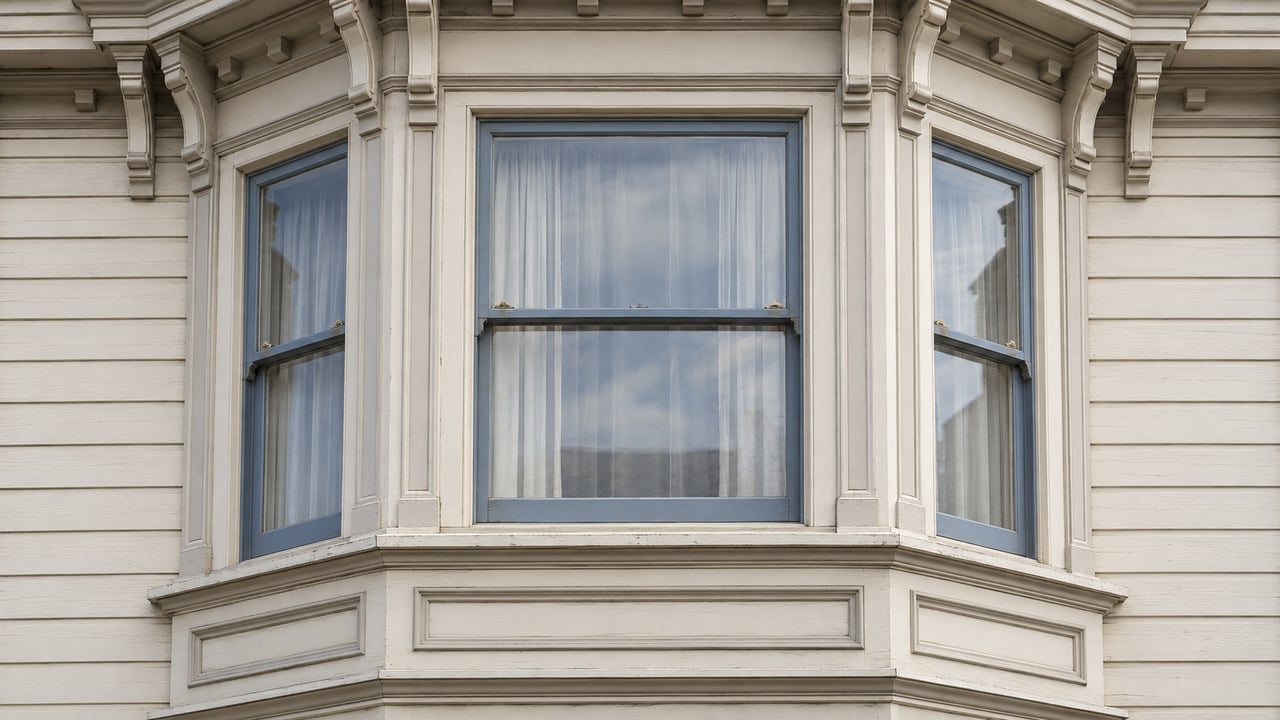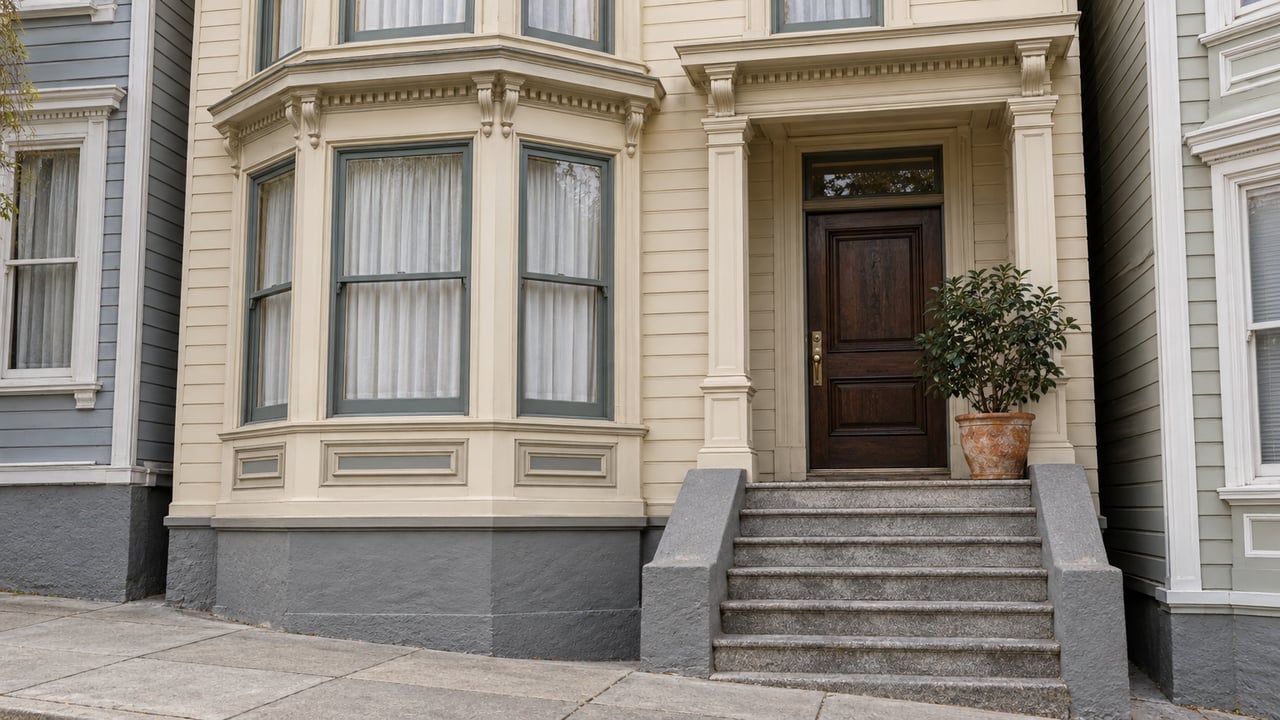
At the corner of Lombard Street and Richardson Avenue, where US 101 traffic heads toward the Golden Gate Bridge, a vacant two-story house built in 1932 sits on a 0.09-acre lot. It is a couple of blocks from the Presidio and three blocks from the Palace of Fine Arts. In July, SF YIMBY reported a concept to replace it with a six-story, 65-foot building of about 20,550 square feet, with 15 homes and no on-site parking.
So far, that address is the clearest sign of San Francisco's biggest rezoning in a generation reaching Cow Hollow. Nine months after the rules took effect, it is still a preliminary concept.
For buyers weighing Cow Hollow, the gap between what the city now allows and what anyone has filed explains a lot. The rezoning gave permission to build. It didn't make building pay. Until the numbers change, new supply in Cow Hollow will be a few small condo buildings on corridor lots, and that does little for the market that matters most here: houses.
What the Rezoning Allowed
San Francisco adopted the Family Zoning Plan on December 9, 2025. Mayor Daniel Lurie signed it on December 12, and it took effect January 12, 2026. SF Planning describes the plan this way:
- Transit and commercial corridors, a category that includes Lombard, generally allow 6 to 8 stories.
- Residential blocks off the corridors generally keep their existing height limits, but lose their density limits.
- Some properties near selected commercial streets can add a floor.
- Corner lots and opportunity sites over 8,000 square feet can go up to six stories.
The plan also created Housing Choice–San Francisco, or HC-SF, a local alternative to the state density bonus. A project can meet HC-SF's affordability terms with on-site affordable units, off-site land dedication, rent-controlled units or a fee. 2629 Lombard uses this pathway. Three of its 15 units would be deed-restricted affordable, and the mix would be two studios, seven one-bedrooms and six two-bedrooms, designed by Studio 12 Architecture.
Union Street was a different case before any of this. The Union Street Neighborhood Commercial District runs along Union from Van Ness to Steiner, with an arm up Fillmore to Lombard. The existing planning code there already encouraged housing above the second story and allowed accessory dwelling units. Not every chance to add housing on Union is new.
The Count by August
The San Francisco Chronicle's August 8 review found that Family Zoning "has arrived with more of a whimper than a bang." Citywide, seven projects had been proposed, adding fewer than 40 housing units. The article described six of them by neighborhood.
| Submissions the Chronicle described, as of August 2026 | Neighborhood |
|---|---|
| Eight condos at 230 Anza St., replacing a vacant duplex; approved | Richmond |
| Two nine-unit buildings | Twin Peaks |
| A triplex | Noe Valley |
| A duplex | Cow Hollow |
| A lot merger: five large apartments and an ADU replacing a single-family home | Upper Market |
The Chronicle didn't give the Cow Hollow duplex's address. The same article listed 2629 Lombard among sites still under consideration, describing a developer "looking at" the 15-home replacement. The research behind this post found no public update on either project after August.
The sizes stand out. Among the submissions the Chronicle described, none was larger than nine units, and Cow Hollow's was two. Under the old rules, 2629 Lombard would have been one house. Even if it's built as drawn, it adds 15 homes.
Why Builders Haven't Rushed In
Earlier rezonings went differently. The Chronicle notes that when the city raised heights in Rincon Hill, Central SoMa, Market-Octavia and the Eastern Neighborhoods, developers bought up sites and competed to break ground as soon as the new rules applied. This time, the paper blamed the slow start on the same forces that have held back market-rate construction since the pandemic: rising construction costs and high interest rates.
That's the key mechanism. Zoning sets the most a project can build. Lenders, contractors and the eventual sale prices decide whether a project gets built at all. A taller height limit on Lombard doesn't change what concrete, labor or a construction loan costs.
The city doesn't see this as permanent. "We've had a multigenerational hole in housing production, and it's going to take time for construction to catch up," SF Planning chief of staff Dan Sider told the Chronicle, adding that "the framework is in place for construction to occur." In the same article, an investor said his firm was "very seriously analyzing a few sites" on transit corridors and expected that "some of the projects will pencil."
The August Rule Change Aimed at Small Lots
Two weeks after the Chronicle's review, the city changed one of those cost inputs. The Board of Supervisors approved an ordinance on July 21, 2026. Mayor Lurie signed it, and it took effect August 22, 2026. According to SF Planning's summary of the Inclusionary Affordable Housing Program, it does the following:
- Removes inclusionary housing requirements for projects of 24 or fewer units.
- Reduces those requirements for projects of 25 units or more.
- Allows land dedication citywide as an alternative to the Affordable Housing Fee.
- Reduces other Article 4 development impact fees.
The 24-unit line is the one to watch in Cow Hollow. The neighborhood's one public example, 2629 Lombard, sits on 0.09 acres and drew a 15-unit concept, which would put it under that line.
There's a caveat on the 5% figure that has circulated. Planning's page credits the 5% on-site rate to the Controller's Technical Advisory Committee, which recommended it on condition that the city find another source of affordable housing funding. The page's summary of the enacted ordinance doesn't print that number. HC-SF's affordability terms are a separate program, tied to the extra density a project requests. The ordinance makes small buildings cheaper to plan. It doesn't lower construction costs or interest rates.
This is general information about how San Francisco's programs work, not legal, tax or financial advice. Anyone weighing a project or purchase should check the specifics of their situation with an attorney, a land-use professional or the Planning Department.
Why This Leaves Cow Hollow's Houses Scarce
Picture Lombard's best case: several small HC-SF buildings like 2629 Lombard, with studios, one-bedrooms and two-bedrooms and no parking. That adds condo-style homes. It doesn't add six-bedroom houses with yards, and that's where Cow Hollow has seen its most extreme bidding.
In May 2026, 2512 Union Street sold for $15 million against a $7.95 million asking price. It's a six-bedroom house of about 5,700 square feet with a brick front patio and a back yard. The San Francisco Standard reported that the price came in 88.68% over asking, a 26-year record for city homes listed above $5 million, and attributed the citywide bidding surge to low inventory. One sale doesn't set a neighborhood price. It shows how much buyers with deep resources will pay when almost nothing comparable is listed.
The latest countywide numbers point the same way. The research found no Cow Hollow-specific or condo-specific figures from the past 90 days, so these are San Francisco County numbers for existing single-family detached homes. In the California Association of Realtors' August 2026 report, released September 16:
- The median price was $1,875,000, down 8.5% from July and up 25.0% from August 2025.
- Active listings were down 53.6% from a year earlier, the steepest drop of any county C.A.R. tracks.
- Unsold inventory stood at 1.3 months, and median time on market was 34 days, compared with 2.3 months and 37 days in August 2025.
Financing explains part of it. The Chronicle reported on October 7 that 33% of San Francisco single-family homes and 43% of condos sold between January 1 and September 1, 2026 closed without a loan. With mortgage rates above 7%, the experts it cited expected sales could slow while prices might hold, and the cash-heavy high end might feel the change less. The same high rates slowing buyers are also slowing builders. Both trends point toward less supply in the near term.
Reading a Block Near Lombard or Union
For a buyer, Family Zoning shows up in two places: a neighboring lot, and the future value of the home being bought. SF Planning publishes an interactive map and separate PDFs of base heights and local-program heights. Block-by-block heights on Lombard and Union weren't confirmed for this post, so the map is the place to check a specific parcel.
The plan points to a few kinds of nearby sites worth checking: a corridor lot on Lombard, a corner lot, a site over 8,000 square feet, or a parcel near a selected commercial street. A low, older building on one of those lots, like the 1932 house at Lombard and Richardson, is the kind of site where a small HC-SF project is most plausible. Whether one gets filed depends on the costs described above.
FAQ
Is 2629 Lombard approved? No. SF YIMBY called the documents preliminary and said the design is likely to change. As of August, the Chronicle described the developer as still considering the project.
Did Family Zoning raise heights on Cow Hollow's residential side streets? Under the plan's general framework, blocks off the corridors keep their existing height limits and lose their density limits. Exceptions apply to certain corner lots, large sites and parcels near selected commercial streets.
Does the August ordinance affect a homeowner adding a unit? It covers inclusionary requirements and impact fees for residential projects. The research here didn't look at single-unit additions, so a homeowner should confirm the details with SF Planning.
If you're looking at a Cow Hollow condo near Lombard, or a house a block or two off Union, and want to know what could realistically go up next door before you write an offer, Erin Govoni and Andrea are happy to go through the zoning map with you, parcel by parcel. Contact Us.